
Blepharoplasty (eyelid surgery)
“Am I going to end up with a strange look?”
It’s the question I hear most, and it’s a fair one: almost everyone knows someone who had their eyelids done and came out looking different. It doesn’t have to happen. If the technical and anatomical parameters are followed, and the surgery is adapted to the shape and size of your eye, all I remove is the excess that time leaves behind. Your look is still yours: it just looks fresher.
- I treat excess skin, drooping eyelids, and bags: upper, lower, or all four.
- The scars don’t show: on top they sit in the eyelid crease, and below just under the lashes.
- It’s outpatient and doesn’t put you out of action: the stitches come out at seven days.
Tell me what bothers you about your eyes and I'll tell you whether this is right for you.
Dr. Saad or his team will reply. No commitment.
What it is
It’s eyelid surgery. Over the years, the skin of the eyelid drops millimeter by millimeter, like a curtain slowly closing. And the fat around the eye shifts out of place and forms what everyone calls bags: mostly in the lower eyelids, and also in the inner part of the upper one.
What I do is remove those excesses —the extra skin and the fat that has shifted— following the anatomy and the contour of your eye. Nothing more. That’s why your look doesn’t change.
Every blepharoplasty is designed for the person: it can be done on the upper eyelids, the lower ones, or all four, and combined with other facial procedures, such as a brow lift or a facelift.
Where the scars go
On top, the scar sits in the eyelid crease. With your eyes open you can’t see it; only when you close them does a small, very discreet line appear.
Below, it runs along the whole edge of the lashes, one millimeter below where they grow. It’s a scar that really doesn’t show.
Eyelid skin is very thin and heals very well. I have never seen keloids on the eyelids.
If what’s drooping is the brow
That’s a brow lift, and I often do it in the same surgery. I make a two-centimeter incision at the edge of the scalp, above the tail of the brow. I don’t lift the whole brow: only the tail, which is what improves the angle of the eye and gives the look a more youthful expression.
-
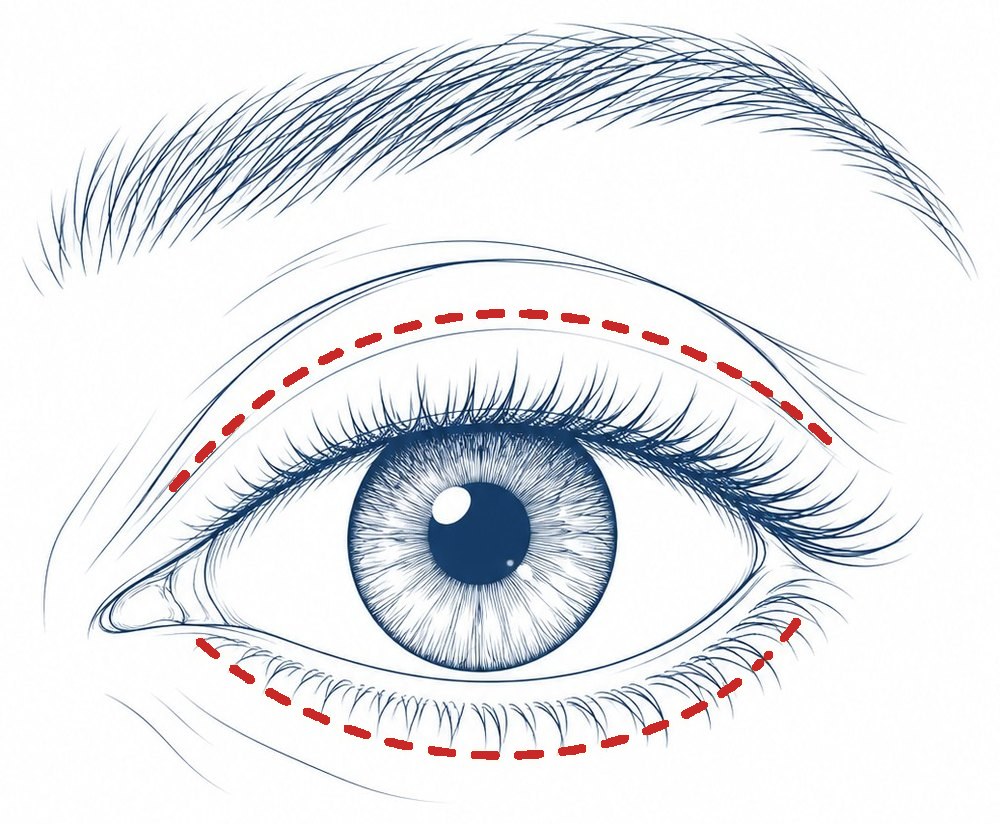
Where the incisions go, in dotted red: on top, in the natural crease of the eyelid; below, just under the lashes.
Where I operate
I see you for consultations in my office in Cali, and I operate in a clinic. I don’t do any procedure in my office, not even a minor one: it’s for consultations, so I can explain everything calmly before you decide.
- I operate in a fourth-level clinic
—the highest level of care in Colombia’s health system— with full medical services: inpatient care, emergency, and intensive care. The operating room is certified by the regional Health Department.
I also operate in Pereira, in a clinic of the same level.
What this surgery doesn't do
It doesn’t erase crow’s feet or fine lines, and it doesn’t remove dark circles: that’s skin color, not excess.
It doesn’t raise the brows. If the brow has dropped, blepharoplasty alone doesn’t correct it; that’s a brow lift.
It doesn’t stop aging. What it does is reduce loose skin and bags in the eyelids. Time keeps passing.
And it doesn’t change your features. If your eyes have the shape that comes with your heritage, surgery doesn’t erase it.
The best candidate is someone looking to improve their eyelids, not for perfection; with realistic expectations and good health.
And what adverse events can occur
All of this is in the consent form you’ll sign. I’m telling you here, calmly and at home, because a decision like this isn’t made with a sheet of paper in your hand ten minutes before going into the operating room.
What’s specific to this surgery
Bruising. It’s the most common: it clears up on its own in about fifteen days.
It’s the most common: it clears up on its own in about fifteen days.
Bleeding. It’s rare, but it can happen during or after surgery, under the skin or, more rarely, around the eye.
It’s rare, but it can happen during or after surgery, under the skin or, more rarely, around the eye. If it does, it may need treatment or emergency surgery. If blood collects and isn’t drained (a hematoma), recovery takes longer and the scar can turn out worse.
Spots and changes in skin color. Bruising can leave spots for weeks, sometimes months and, rarely, for good.
Bruising can leave spots for weeks, sometimes months and, rarely, for good. That’s why it’s so important to protect yourself from the sun for the first three months.
Asymmetry. The two sides of the face are never the same, not even before surgery.
The two sides of the face are never the same, not even before surgery. Afterwards there may be some difference between one eye and the other, and that doesn’t mean a bad result.
And, very rarely, skin damage from poor blood supply, which may need other surgeries to repair.
from poor blood supply, which may need other surgeries to repair.
What applies to any surgery Infection (it’s uncommon in this surgery and is treated with antibiotics or, sometimes, with another surgery), allergies or reactions to medications and anesthesia, clotting problems, and blood clots that travel to the lungs.
Infection (it’s uncommon in this surgery and is treated with antibiotics or, sometimes, with another surgery), allergies or reactions to medications and anesthesia, clotting problems, and blood clots that travel to the lungs. They’re uncommon, but some can be serious and even life-threatening.
If healing goes outside the normal range. Every body heals in its own way.
Every body heals in its own way. If an unusual change appears, it can also be corrected in a second procedure, at the right time.
If something gets complicated. Treatment may require a hospital stay and lengthen your recovery and your return to work.
Treatment may require a hospital stay and lengthen your recovery and your return to work. Those costs are paid by the patient.
What I can’t guarantee you. Neither perfect symmetry nor an exact result.
Neither perfect symmetry nor an exact result. Surgery, like medicine in general, commits to the means, not to the result.
If any of this worries you, that's exactly what we should talk about before you decide — not after.
Alternatives and related procedures
- Facelift — if, besides your eyelids, you’re concerned that your face has dropped.
- About Dr. Saad Barhoum — training, certification, and registration.
How to prepare
- 1 · The consultation.
We talk, go over your medical history and your lab tests to make sure everything is in order, and discuss expectations. This is where we decide which eyelids, whether it’s done alone or with the brows, and what to expect in your case.
- 2 · No aspirin or anti-inflammatories from 15 days before.
It’s the minimum I ask for any surgery: they increase the risk of bleeding. And if you have high blood pressure, it has to be well controlled before surgery.
- 3 · You don’t need an eye-doctor evaluation beforehand.
In this surgery I only work on the surface skin of the eyelids: I don’t touch the eyeball. Keep up with the checkups you already have with your ophthalmologist because of your age or a condition, but the surgery doesn’t require a special one.
What I need you to tell me
To assess you safely and recommend the best option for your case, I need to know all of your information:
- Previous surgeries, including implants or earlier procedures.
- Medications — everything you’re taking, including vitamins and supplements.
- Medical history: illnesses, allergies, or significant conditions.
- Tests and medical records. If you have previous results, bring them to the consultation.
When it comes to your health, no information is too small.
- You don’t need to know which surgery you need. That’s my job.
What does help is arriving knowing what bothers you and what you’d like to achieve: that’s how I understand your expectations and explain the options in your case.
Ask me everything —the procedure, the risks, recovery time, the results you can expect. There are no silly questions. If you’re an adult, you can bring someone with you to the consultation, though you don’t have to. If you’re a minor, you must come with a trusted companion.
Surgery shouldn’t be an impulse decision. Take all the time you need.
Getting back to your life
| Surgery day | I operate under local anesthesia with sedation, and it takes about an hour and a half. |
| The same day | You go home. It’s outpatient surgery, it isn’t painful, and it doesn’t put you out of action physically. We send you lubricating eye drops to use during the first month. |
| The first 15 days | The bruising goes away on its own. It starts purple, turns green, then yellow, and disappears. There are creams that speed it up by a few days. |
| At 7 days | The eyelid stitches come out. If I also did a brow lift, those stitches come out at 15 days. |
| Screens and work | You can keep working. The only limit is tasks that demand a lot of visual attention: no more than an hour in a row in front of a screen, with five- or ten-minute breaks. If you work with screens or LED lights, wear blue-light glasses, and sunglasses when you go out. |
| Makeup and creams | Makeup, once the stitches are out. Sunscreen and scar creams, 15 days after all the stitches are out. |
| At one month | Exercise, starting gradually, and contact lenses again. |
| The first 3 months | No direct sun or ultraviolet light. They can fix the bruise pigment in the skin and leave a permanent spot. |
- Follow-up visits.
At 8 days the nurse sees you for wound care; at 15, I check your healing myself; and after that, one a month until the third month. If you live in another city or country, the monthly visits are by video call.
Frequently asked questions
Will I end up with a strange look, or with my eyes too wide open? There’s no reason to.
There’s no reason to. If the technical and anatomical parameters are respected, and the surgery is adapted to the shape and size of your eye, I only remove the excess that time has left. That way there’s no reason for your features or the shape of your eyes to change, or for the eye to end up too open or dry.
Will the scars show? On top, the scar is hidden in the eyelid crease: with your eyes open you can’t see it.
On top, the scar is hidden in the eyelid crease: with your eyes open you can’t see it. Below, it runs just under the lashes. Eyelid skin heals very well.
How long does the bruising last? About fifteen days, which is what any bruise under the skin takes to clear.
About fifteen days, which is what any bruise under the skin takes to clear. It changes color —purple, green, yellow— until it disappears.
Will it put me out of action? Not physically.
Not physically. You can go out and keep working; what you need to watch is screen use and the sun.
Does blepharoplasty remove dark circles or crow’s feet? No.
No. It removes excess skin and bags. Dark circles are skin color, and crow’s feet are wrinkles: neither changes with this surgery.
What if what’s drooping is my brow? Then blepharoplasty alone won’t fix it.
Then blepharoplasty alone won’t fix it. That’s a brow lift, and I often do it in the same surgery.
Is it only cosmetic? Not always.
Not always. When the upper eyelid skin droops a lot, it can get in the way of your vision.
If you're traveling from outside Colombia
Having surgery abroad changes the logistics, not the medicine. What changes is how long you need to stay, who sees you once you’re back home, and when you can get on a plane.
I recommend staying at least 15 days, even though the surgery is small. The time isn’t set by the size of the surgery but by healing: before you travel, I want to see that it’s going well, and that takes fifteen days.
If you need to travel sooner, I’ll check you before you leave. If healing is going well, I’ll clear you, on one condition: that you keep telling me how you’re doing, with photos or by video call, in case you need a recommendation or a different medication.
The next step
If, when you look in the mirror, you see a more tired look than you feel, this is decided by seeing you. Tell me what bothers you and we’ll look at it.
The information on this page is educational and does not replace an in-person medical consultation. No result is guaranteed: what can be achieved in your case, and its risks, are discussed in consultation and set out in the informed consent form you sign before surgery.