
Otoplasty (ear surgery)
Prominent ears are one of the few things in plastic surgery worth fixing in childhood.
Not for looks: for school. Children whose ears stick out suffer a lot from teasing, and it weighs on them emotionally. That’s why it’s one of the plastic surgeries that can be done earliest: from age seven, once the ear has finished growing.
- It’s for prominent ears: ears that stick out from the head and open forward.
- It can be done from age seven, once the ear has finished growing.
- I don’t cut the cartilage: I fold it with stitches, and the scar is hidden behind the ear.
Tell me what bothers you about your ears —or your child's— and I'll tell you whether this is right for you.
Dr. Saad or his team will reply. No commitment.
What it is
The most common problem is ears that open forward —what people call “bat ears” or “sticking-out ears.” It’s a condition present from birth: the cartilage of the ear’s bowl (the concha) opens outward at an angle and pulls away from the skull. Often the fold at the top of the ear, the antihelix, is also missing, and that makes the ear look different.
Otoplasty consists, above all, of repositioning that cartilage to bring the ear closer to the head.
How I do it
The incision goes behind the ear, in the crease between the ear and the skull. It’s completely hidden.
I don’t cut the cartilage. Ear cartilage has no blood vessels of its own to nourish it, so it’s very delicate: any trauma can cause it to be lost, and that would be serious. That’s why I use a technique that doesn’t damage or cut it. With precisely placed stitches, I fold it to bring it closer to the skull and close the angle.
I remove the excess skin behind the ear. Cartilage has memory and tends to go back to its position; removing that skin helps keep it from doing so.
And I rebuild the antihelix when it’s missing. That fold changes how the ear looks and also helps receive sound waves.
The anesthesia
In young children I prefer general anesthesia, so they’re not left with a feeling of trauma from the surgery: general anesthesia leaves no memory of the procedure. From age twelve, and in adults, it can be done with local anesthesia and light sedation. The surgery takes about an hour.
If it’s your son or daughter
Legally, a minor can have this surgery, because it’s a condition present from birth. But every minor who has surgery needs a written authorization signed by both parents and notarized.
The most important thing is to catch it in time and talk it through with the child.
-
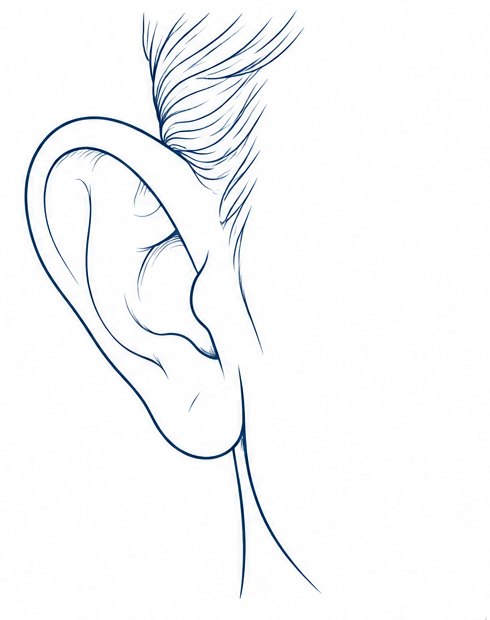
1 Before: the ear sticking out from the head.
-
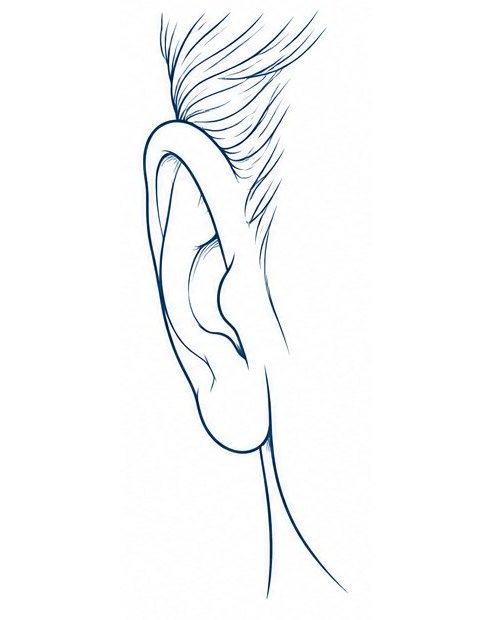
2 After: the ear closer to the head.
-
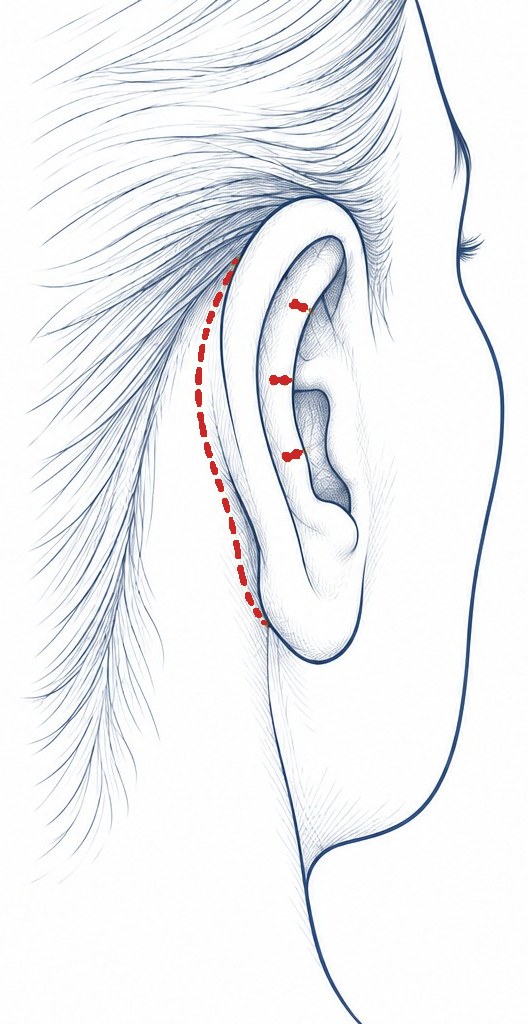
3 Where the incision goes, in dotted red: behind the ear, hidden in the crease.
Where I operate
I see you for consultations in my office in Cali, and I operate in a clinic. I don’t do any procedure in my office, not even a minor one: it’s for consultations, so I can explain everything calmly before you decide.
- I operate in a fourth-level clinic
—the highest level of care in Colombia’s health system— with full medical services: inpatient care, emergency, and intensive care. The operating room is certified by the regional Health Department.
I also operate in Pereira, in a clinic of the same level.
And what adverse events can occur
All of this is in the consent form you’ll sign. I’m telling you here, calmly and at home, because a decision like this isn’t made with a sheet of paper in your hand ten minutes before going into the operating room.
What’s specific to this surgery
The ear moving back toward its old position. In exceptional cases, over time, an internal stitch comes loose and the ear pulls away again, completely or partly.
In exceptional cases, over time, an internal stitch comes loose and the ear pulls away again, completely or partly. It’s corrected with another operation.
Asymmetry. The two halves of the body have differences from birth, and so does the face.
The two halves of the body have differences from birth, and so does the face. I always aim for symmetry, and what’s soft tissue can be corrected; what depends on bone can’t. If a very obvious difference remains afterwards, it’s corrected with another surgery.
Changes in sensation. Some people feel the area numb or, the other way around, more sensitive.
Some people feel the area numb or, the other way around, more sensitive. It’s a small area and usually not a problem, except in the cold: then you need to protect the ear more.
The scar. The incision is hidden, but in some people the skin doesn’t heal well and the scar stays visible because of its shape or color.
The incision is hidden, but in some people the skin doesn’t heal well and the scar stays visible because of its shape or color. If you tend to form keloids, healing can be slow and uncomfortable. Rarely, the body rejects an internal stitch.
Bleeding. From the incision or between the skin and the cartilage.
From the incision or between the skin and the cartilage. It’s usually not serious and is easily resolved.
Infection of the skin, the cartilage, or the internal stitches.
of the skin, the cartilage, or the internal stitches. It’s unlikely and is treated with antibiotics; if it leaves scar tissue, it may need to be removed surgically.
Pain that lasts. It’s uncommon and is managed with medication.
It’s uncommon and is managed with medication.
What applies to any surgery Spots or changes in skin color, which are rarely permanent; very rarely, skin damage from poor blood supply; allergies or reactions to medications and anesthesia, clotting problems, and blood clots that travel to the lungs.
Spots or changes in skin color, which are rarely permanent; very rarely, skin damage from poor blood supply; allergies or reactions to medications and anesthesia, clotting problems, and blood clots that travel to the lungs. They’re uncommon, but some can be serious and even life-threatening.
If something gets complicated. A second surgery, a hospital stay, or additional treatment can lengthen your recovery and your return to school or work, and those costs are paid by the patient.
A second surgery, a hospital stay, or additional treatment can lengthen your recovery and your return to school or work, and those costs are paid by the patient.
What I can’t guarantee you. Neither perfect symmetry nor an exact result.
Neither perfect symmetry nor an exact result. Surgery commits to the means, not to the result.
If any of this worries you, that's exactly what we should talk about before you decide — not after.
Alternatives and related procedures
- About Dr. Saad Barhoum — training, certification, and registration.
How to prepare
- 1 · The consultation.
We talk, go over your medical history and your tests, and discuss what bothers you and what can be achieved. If it’s your child, I also talk with them.
- 2 · No aspirin or anti-inflammatories from 15 days before.
It’s the minimum I ask for any surgery. And if you have high blood pressure, get it under control before surgery: you bleed more.
What I need you to tell me
To assess you safely and recommend the best option for your case, I need to know all of your information:
- Previous surgeries, including implants or earlier procedures.
- Medications — everything you’re taking, including vitamins and supplements.
- Medical history: illnesses, allergies, or significant conditions.
- Tests and medical records. If you have previous results, bring them to the consultation.
When it comes to your health, no information is too small.
- You don’t need to know which surgery you need. That’s my job.
What does help is arriving knowing what bothers you and what you’d like to achieve: that’s how I understand your expectations and explain the options in your case.
Ask me everything —the procedure, the risks, recovery time, the results you can expect. There are no silly questions. If you’re an adult, you can bring someone with you to the consultation, though you don’t have to. If you’re a minor, you must come with a trusted companion.
Surgery shouldn’t be an impulse decision. Take all the time you need.
Getting back to your life
| Coming out of surgery | A bandage around the head. It keeps the area clean, protects it from bumps, and holds the ears in their new position while they start to heal. |
| After a few days | You switch the bandage for a headband that holds the ears, following my instructions. I recommend wearing it for three months. |
| At 15 days | Back to school or work. |
| At one month | Exercise, starting gradually. It’s what I recommend after any surgery. |
Frequently asked questions
From what age can it be done? From age seven, when the ear has finished growing.
From age seven, when the ear has finished growing. That’s exactly the age when children move from kindergarten to school, which is where they suffer the most teasing.
Does the scar show? No: it’s hidden in the crease between the ear and the head.
No: it’s hidden in the crease between the ear and the head.
Do you cut the cartilage? No.
No. Ear cartilage is very delicate, because it has no blood vessels of its own. I fold it with stitches to bring it closer to the head, without cutting it.
Will my child be awake? If they’re young, no: I prefer general anesthesia, which leaves no memory of the surgery.
If they’re young, no: I prefer general anesthesia, which leaves no memory of the surgery. From age twelve it can be done with local anesthesia and light sedation.
Will both ears end up the same? I always aim for symmetry.
I always aim for symmetry. But the two halves of the body come with differences from birth: what’s soft tissue I can correct; what depends on bone, I can’t.
Can the ear stick out again? In exceptional cases, yes: if an internal stitch comes loose.
In exceptional cases, yes: if an internal stitch comes loose. To prevent it, besides the stitches I remove the excess skin behind the ear. If it happens, it’s corrected with another surgery.
If you're traveling from outside Colombia
Having surgery abroad changes the logistics, not the medicine. What changes is how long you need to stay, who sees you once you’re back home, and when you can get on a plane.
I recommend staying at least 15 days, even though the surgery is small. The time isn’t set by the size of the surgery but by healing: before you travel, I want to see that it’s going well.
If you need to travel sooner, I’ll check you before you leave. If healing is going well, I’ll clear you, on the condition that you keep telling me how you’re doing, with photos or by video call.
The next step
If your ears bother you —or your son’s or daughter’s— this is decided by seeing them. Tell me and we’ll look at it.
The information on this page is educational and does not replace an in-person medical consultation. No result is guaranteed: what can be achieved in your case, and its risks, are discussed in consultation and set out in the informed consent form you sign before surgery.