Breast augmentation and breast lift
“I’m really afraid my result won’t look natural.”
That is, word for word, the sentence I hear most in consultation. The second thing I see most is a mistake from the start: coming in worried only about size, or comparing yourself to a friend. That’s what this page is about —what can be done and how I decide— and also about what I can’t promise you.
- If you’re missing volume, it’s an augmentation. If the breast has dropped, it’s a lift — and an implant alone won’t fix that.
- Many cases are both, and that’s decided when I see you.
- You don’t need to arrive with your mind made up.
Tell me about your case and I'll tell you whether it's about volume, position, or both.
Dr. Saad or his team will reply. No commitment.
What it is
Breast augmentation is the surgery that gives the breasts shape and volume with implants. It’s considered when, because of genetics or other factors, the breasts are smaller than usual, and also after stages of life in which the breast has lost volume.
That is exactly what the implant was created for. And there are three situations in which I consider it essential, because I have no other device that solves the problem: severe atrophy of the breast gland; Poland syndrome —a congenital condition that leaves a marked asymmetry between the two breasts—; and reconstruction after breast cancer. These are medical indications, not cosmetic ones, and it’s worth knowing they exist.
About their safety, I’ll tell you what I say on camera: breast implants are medical devices that have been studied and approved by health authorities —INVIMA in Colombia, the FDA in the United States. They’re not “the enemy.” And they’re not an irreversible decision: they go in when they’re needed and come out when you no longer want them.
Augmenting isn’t the same as lifting
This is the distinction people find hardest, and the one I explain most carefully.
Pexy comes from a classical root meaning to fix in place, and a breast lift (mastopexy) raises the gland and the nipple-areola complex back to where they used to be.
Why is that position lost? Because of the hormonal stages of your life —pregnancy, the months after giving birth, breastfeeding— and because of weight changes: the skin loses firmness, the breast stretches and drops, and the areola drops with it.
The practical consequence is this: if your problem is sagging, an implant alone won’t solve it. A lift can be done with or without an implant, and that’s something we decide in the consultation, together. An augmentation solves volume. A lift solves position. Many cases need both; some need only one.
An implant alone won't fix sagging.
How I choose your implant
This is where the real work is, and it isn’t “one size up.”
I choose four things, not one: size, shape, consistency, and projection. And I match those four to your weight, your height, and the shape of your chest.
I also assess you from the side. Hardly anyone explains this, and it’s where you can tell whether the result will look balanced: from the side, I see the proportion between your breasts, your buttocks, and your waist. Any disproportion between the parts throws off the harmony, and even if each part is done well, it won’t look beautiful.
That’s why the question “what size should I get?”, the way it usually comes up, already has the mistake built in.
If you want to know which implant suits you, that's decided by looking at your case, not at a catalog.
Send me your questions Why I look at the whole body, not just the breast →
Where I go in, and where the implant sits
I go in through a small incision along the lower edge of the areola —a scar I call “intimate”—, reach the pectoralis major muscle, and lift it to create the space where I place the implant. That way it’s covered by the muscle, the breast tissue, and the skin. I prefer this approach because it doesn’t compromise the nerves or the blood supply of the breast, leaves a discreet scar, and doesn’t form keloids, unlike an incision in the crease beneath the breast or in the armpit.
I do it this way for two reasons: it helps the recovery and the final shape, and it keeps the implant and the breast gland from interacting.
And I’ll tell you something others don’t: it’s one option among several techniques, and it’s used in selected cases. If in your consultation I suggest a different approach, it isn’t a downgrade: it means your case is different.
What I mean when I say “natural”
I won’t answer you with adjectives. I’ll answer with three concrete things.
- First
I operate following technical parameters based on the rigid structures of your body: your skeleton and your muscles. If I shape the breast according to them, the result stays natural. Second, what I change are soft tissues —fat and skin— using techniques I tailor to each case. Third, your recovery and your habits are part of the result.
You may or may not agree with that framework. What I want is for it to be something you can check, and something I can explain to your face.
-
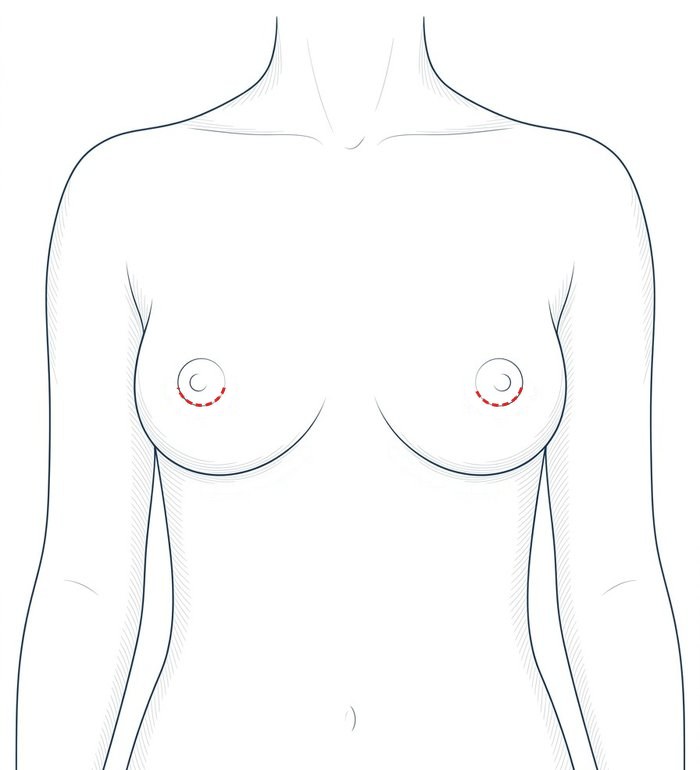
1 The incision, in a dashed red line: along the lower edge of the areola. It is discreet and heals better.
-
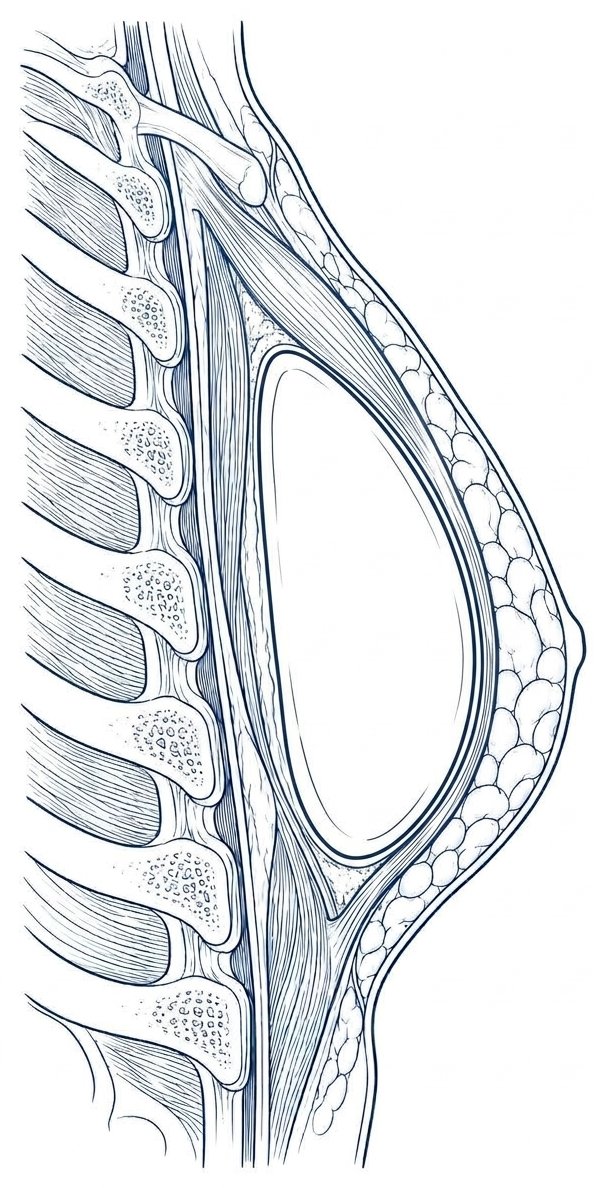
2 The implant goes behind the pectoral muscle, which covers it in front.
Where I operate
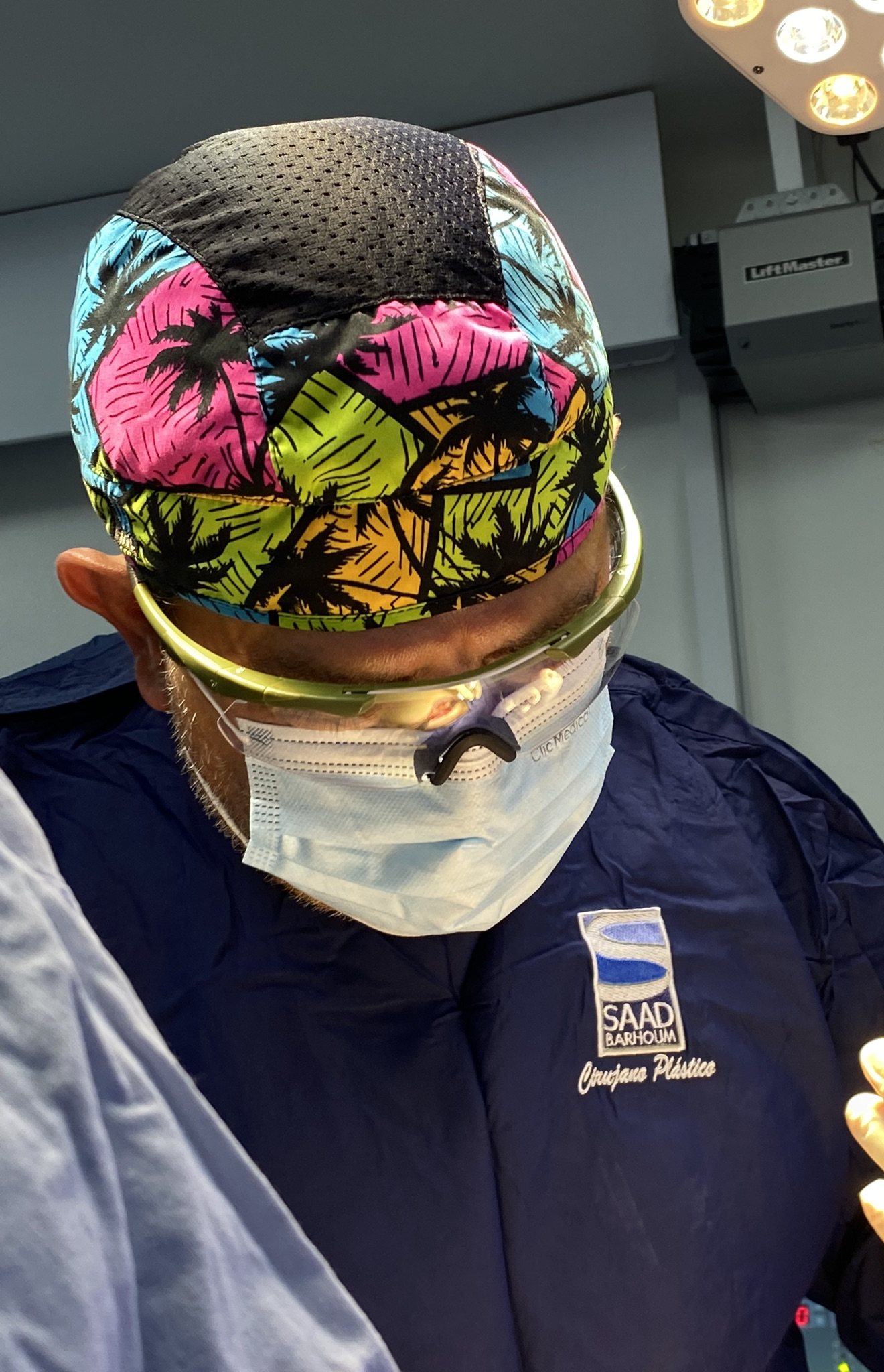
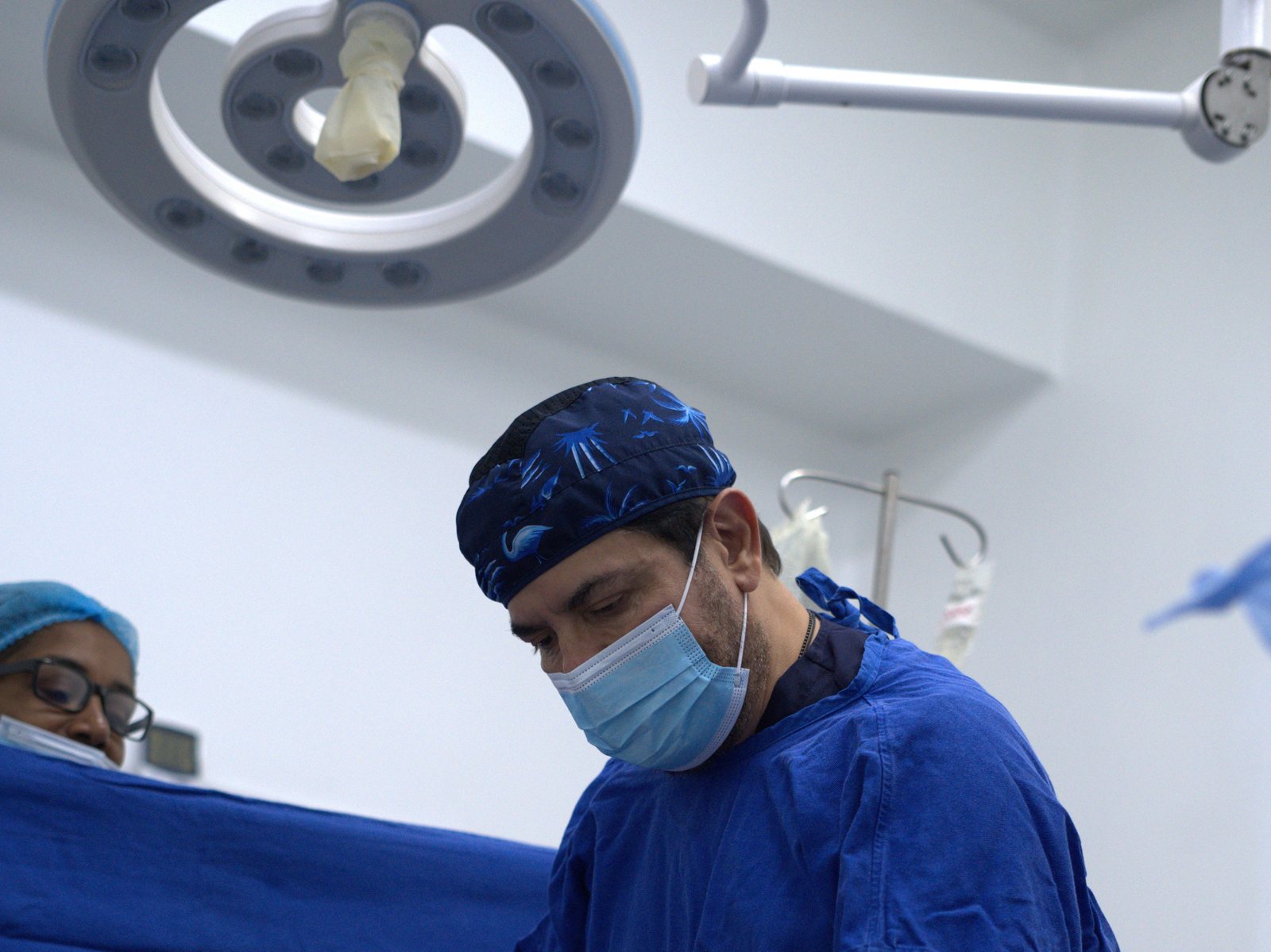
I see you for consultations in my office in Cali, and I operate in a clinic. I don’t do any procedure in my office, not even a minor one: it’s for consultations, so I can explain everything calmly before you decide.
I operate in a fourth-level clinic —the highest level of care in Colombia’s health system— with full medical services: inpatient care, emergency, and intensive care. The operating room is certified by the regional Health Department.
I also operate in Pereira, in a clinic of the same level.
What this surgery doesn't do
I can’t guarantee the final size or appearance. It doesn’t depend only on the implant: it also depends on your breast tissue, which changes with your weight and your hormones. I expect the best results. I can’t guarantee them.
Your two sides aren’t identical, and they never will be. No body is symmetrical. I work so the difference isn’t noticeable; not so it disappears, because it can’t.
You will have a scar. It’s a permanent mark on the skin, and you’ll only see how it has settled after a year. I decide where it goes and how I close it. What I don’t control is your skin: how it finally looks depends on your collagen, and that’s something you’re born with and inherit — it doesn’t depend on the technique or the suture material. If you smoke, your scar will be worse, and no technique can fix that.
An implant isn’t for life. It’s a synthetic product and its materials wear over time. Manufacturers of every brand recommend considering a replacement from ten years on, and when that time comes, what I’ll ask for is a breast ultrasound to see what condition it’s in. If you’re already at that point, this is where your story starts: when it’s time to replace them.
Bigger isn’t better. I operated again on a 21-year-old patient whose lower breast had dropped under the weight of the implant eight months after her first augmentation with another surgeon. Choosing “as big as possible” isn’t a strategy: it’s a problem put off for later.
And the fear you bring is normal. About 98% of my patients arrive afraid, and not of the surgery itself: of the scar, the pain, and the anesthesia.
And what adverse events can occur
This isn’t here to scare you. It’s here because it’s what you sign before going into the operating room, and I’d rather you read it calmly before you sit down with me.
From the implant. The body always forms a capsule of tissue around the implant.
The body always forms a capsule of tissue around the implant. In some cases that capsule hardens and squeezes it, causing discomfort or pain: that’s capsular contracture, and it can be corrected with surgery. And in a very small percentage of cases, the body doesn’t tolerate the material and the implant has to be removed.
From the recovery. After surgery, there may be bruising from bleeding, fluid buildup around the implant (seromas), milk collecting inside the breast, or an infection, on the skin or around the implant.
After surgery, there may be bruising from bleeding, fluid buildup around the implant (seromas), milk collecting inside the breast, or an infection, on the skin or around the implant. If that happens, you may need one or more additional surgeries, medical treatment, or both.
From life afterward. A hard blow to the chest —in a car accident, for example— can rupture an implant and cause a hematoma or an infection.
A hard blow to the chest —in a car accident, for example— can rupture an implant and cause a hematoma or an infection. In that case the area has to be repaired and the damaged implant removed or replaced.
And the risks of any surgery , which are uncommon: bleeding from clotting problems; changes in blood flow to the skin, which can damage the areola, the nipple, or another part of the breast; allergies or reactions to medications or materials; complications from anesthesia; blood clots that travel to the lungs; and, in very rare cases, heart or lung complications that can be life-threatening.
Which are uncommon: bleeding from clotting problems; changes in blood flow to the skin, which can damage the areola, the nipple, or another part of the breast; allergies or reactions to medications or materials; complications from anesthesia; blood clots that travel to the lungs; and, in very rare cases, heart or lung complications that can be life-threatening.
I’m telling you all of it because that’s how it’s written in my consent form, and because every surgery, big or small, carries risks.
If any of this is holding you back, that's exactly what we should talk about before you decide — not after.
Alternatives and related procedures
- Breast implant exchange — if you already have implants and it’s time to check or replace them.
- Breast explant surgery — having them removed without replacing them, rebuilding shape and volume with your own tissue.
- Tummy tuck — often part of the same surgical plan as breast surgery.
- Buttocks and fat transfer — because the proportion I look for considers the whole body from the side, not the breast on its own.
- Who Dr. Saad Barhoum is — training, certification, and registration, so you can check them.
How to prepare
Every surgery has three acts, and the first is the preparation: the interview with me, your medical history, your lab tests, and an honest conversation about expectations and risks.
- 1 · The consultation.
This is where the important things are decided: whether your case is about volume, position, or both, and which implant suits your body. I also assess you from the side. Come with your questions about the scar, size, and pain: those are the three worries I hear most.
- 2 · Medical history and lab tests.
Before going into the operating room, I make sure everything is in order.
- 3 · The checking that’s up to you.
Verify the training, specialist certification, and registration of whoever is going to operate on you. Mine too. In Colombia, plastic surgery is a medical specialty of at least four years, with a degree recognized by the Ministry of Education, and the surgeon must be listed in RETHUS, the national registry of health professionals.
What I need you to tell me
To assess you safely and recommend the best option for your case, I need to know all of your information:
- Previous surgeries, including implants or earlier procedures.
- Medications — everything you’re taking, including vitamins and supplements.
- Medical history: illnesses, allergies, or significant conditions.
- Tests and medical records. If you have previous results, bring them to the consultation.
When it comes to your health, no information is too small.
- You don’t need to know which surgery you need. That’s my job.
What does help is arriving knowing what bothers you and what you’d like to achieve: that’s how I understand your expectations and explain the options in your case.
Ask me everything —the procedure, the risks, recovery time, the results you can expect. There are no silly questions. If you’re an adult, you can bring someone with you to the consultation, though you don’t have to. If you’re a minor, you must come with a trusted companion.
Surgery shouldn’t be an impulse decision. Take all the time you need.
Getting back to your life
- For an augmentation without a lift:
7 days off work, with no strain on your arms.
- Follow-up visits.
The first at 4 days, the second at 8, and stitch removal at 15. If any stitches remain, we continue weekly.
- The first few days.
My anesthesiologist specializes in pain management, and not only during surgery: afterward too. Breast surgery doesn’t require post-op lymphatic drainage massages to bring down the swelling.
- The first 20 days.
No driving. With a lift, I add: no sudden arm movements, no strain, about 15 days off work, and, if you’re coming from another city, no traveling until the 20 days are up.
- The first month.
In breast surgery after implant removal, about 70% of the swelling has gone down at one month and the pain is moderate.
- Up to three months.
The bra I recommend, for three months. No strain and no heavy lifting. After a lift, sun and weights come back from three months on.
- After that.
The implant goes on your calendar: at ten years, a breast ultrasound.
- And part of it is up to you.
The third act of any surgery is the recovery, and that’s where you do the work: following the instructions, your diet, hydration, prescriptions, and follow-up visits. Surgery doesn’t start with the surgeon: it starts with well-made decisions, and it ends with following the recommendations well.
Frequently asked questions
Will people be able to tell I’ve had surgery? That’s the one I’m asked most.
That’s the one I’m asked most. I operate based on your rigid structures —skeleton and muscles—; what I change are soft tissues, case by case; and your recovery, your diet, and your exercise are part of the result. What I can’t do is guarantee you a specific result: my commitment is to the care I provide, not to a guaranteed outcome.
What size should I get? Asked that way, the question is already one of the two mistakes I see most.
Asked that way, the question is already one of the two mistakes I see most. I choose size, shape, consistency, and projection, and I match them to your weight, your height, and the shape of your chest, looking at you from the side as well. The other mistake is comparing yourself to a friend.
Do I need an augmentation or a lift? It depends on whether your problem is volume or position.
It depends on whether your problem is volume or position. A lift raises the gland and the nipple-areola complex. It can be done with or without an implant: it depends on what you prefer and how much the tissue has thinned. We decide it together in consultation.
Where will the scar be? With my technique, along the lower edge of the areola, not in the crease beneath the breast.
With my technique, along the lower edge of the areola, not in the crease beneath the breast. It’s one option among several and it’s used in selected cases. Either way, a scar is unavoidable: what I work on is where it goes, how I close it, and how I follow its healing over the year it takes to settle.
Are they safe? Are they forever? I don’t recommend brands: I only use implants registered with INVIMA and, preferably, also approved by the FDA and carrying the European CE mark.
I don’t recommend brands: I only use implants registered with INVIMA and, preferably, also approved by the FDA and carrying the European CE mark. The manufacturer guarantees their quality; INVIMA certifies that they’re suitable for use in Colombia, not me. They aren’t forever: they’re a synthetic product that wears over time, and from ten years on it’s time to consider replacing them. And if one day you decide you don’t want them anymore, removing them is also an option.
Will I be able to breastfeed? Yes.
Yes. The implant goes behind the muscle and the breast gland is left intact.
If you're traveling in for surgery
Having surgery in Cali doesn’t change the operation, but it does change the planning.
If you’re coming from out of town: a recommended minimum of 15 days in the city. If I also do a breast lift, the minimum is 20 days. It’s a minimum: if you can stay longer, even better. Once that time is up, you can fly home.
Flights, paperwork, where to stay while you recover, remote follow-up, and what happens if something comes up once you’re back home: it’s all in Your journey.
The next step
If you’re not sure whether your case is about volume, position, or both, that’s exactly the conversation to have before anything else. And you don’t need to arrive with your mind made up.
The information on this page is educational and does not replace an in-person medical consultation. No result is guaranteed: what can be achieved in your case, and its risks, are discussed in consultation and set out in the informed consent form you sign before surgery.