
Buttock augmentation
You’re not here because your buttocks are small. You’re here because, looking at yourself from the side, the whole picture doesn’t add up.
Your waist, hips, and buttocks aren’t in proportion, and you’ve been trying to fix it at the gym for a while. That’s the real conversation, and it’s a conversation about proportion, not volume. That’s why, when I assess you, I also look at you from the side: that’s where you can see the relationship between the size of your breasts, your waist, and your buttocks, and any disproportion between the parts will throw off the harmony. Bigger buttocks on an unbalanced figure don’t solve the problem: they just move it somewhere else.
- “Buttock surgery” is four different operations, not one.
- If your issue is sagging, adding volume won’t help — it’s corrected another way, and I’ll tell you which in the consultation.
- To augment, there are two options and only two: an implant or your own fat.
Tell me what you'd like to change and I'll tell you which of the four it is.
Dr. Saad or his team will reply. No commitment.
What can be done with the buttocks
Under the name “buttock surgery,” there are four different goals:
- Increasing size.
- Changing shape.
- Reducing size, when the buttocks are too large.
- Lifting the buttocks, when they’ve dropped over time.
They’re four different problems with four different approaches. Mixing them up is the first mistake: if what you have is sagging, adding volume won’t make it better.
When the goal really is to augment, there are two options, and only two:
With implants. A synthetic material placed inside the buttock.
With your own fat. First I do liposculpture: I remove fat from where there’s too much, and I use that same tissue to give volume and shape to the buttocks.
And here’s a common confusion worth clearing up: liposculpture isn’t the same as liposuction. Liposuction is only removing fat from specific areas. Liposculpture is the complete procedure, done in an orderly, step-by-step way across the whole body, to shape your entire figure and reuse that fat where it’s needed. If what you’re offered is liposuction with a bit of fat put in the back, this isn’t that.
“Buttock surgery” is four different operations.
Increase
the size
Shape
change the silhouette
Reduce
when they're too large
Lift
when they've dropped over time
If your issue is sagging, adding volume won't help.
How I place the fat: above the muscle, and watching it go in
This is the part I most want you to understand, because it’s where the safety of this surgery lies.
- The fat doesn’t go into the muscle. I place it above it
In the fatty tissue of the buttock.
And I don’t do it blind. Today we have portable ultrasound devices, with the image on a phone or an iPad. During surgery, we cover the ultrasound probe with a sterile sleeve to keep it sterile, and with it we watch how deep the cannula I use to inject the fat is going, and into which tissue. That’s the current technique, the most advanced one.
Why do I avoid the muscle? Because that’s where the real risk is: if fat gets into the muscle, it can enter the bloodstream, and that’s what’s dangerous about this surgery. That’s why it’s avoided, and the fat is placed in the fatty tissue of the buttock.
In the operating room, the ultrasound shows the skin, the fatty tissue, the gluteus maximus, the piriformis muscle, the ischial tuberosity, and the greater trochanter. I know where the cannula is at every moment, instead of relying on landmarks on the outside of the body.
In medical terms, in case you want to compare notes with your own surgeon Autologous fat grafting in the supramuscular plane under intraoperative ultrasound guidance, with the probe covered by a sterile sleeve. The intramuscular plane is deliberately avoided because of the risk of fat embolism, the fatal complication associated with buttock fat grafting.
If you want to ask me about the plane, the ultrasound, or anything else about this surgery, write to me and I'll explain it with your case in front of me.
Tell me about your case How I work on the rest of your contour →
Your own fat
Taken from where there's too much and placed where it's missing. Above the muscle, guided by ultrasound.
An implant
A synthetic material inside the buttock.
-
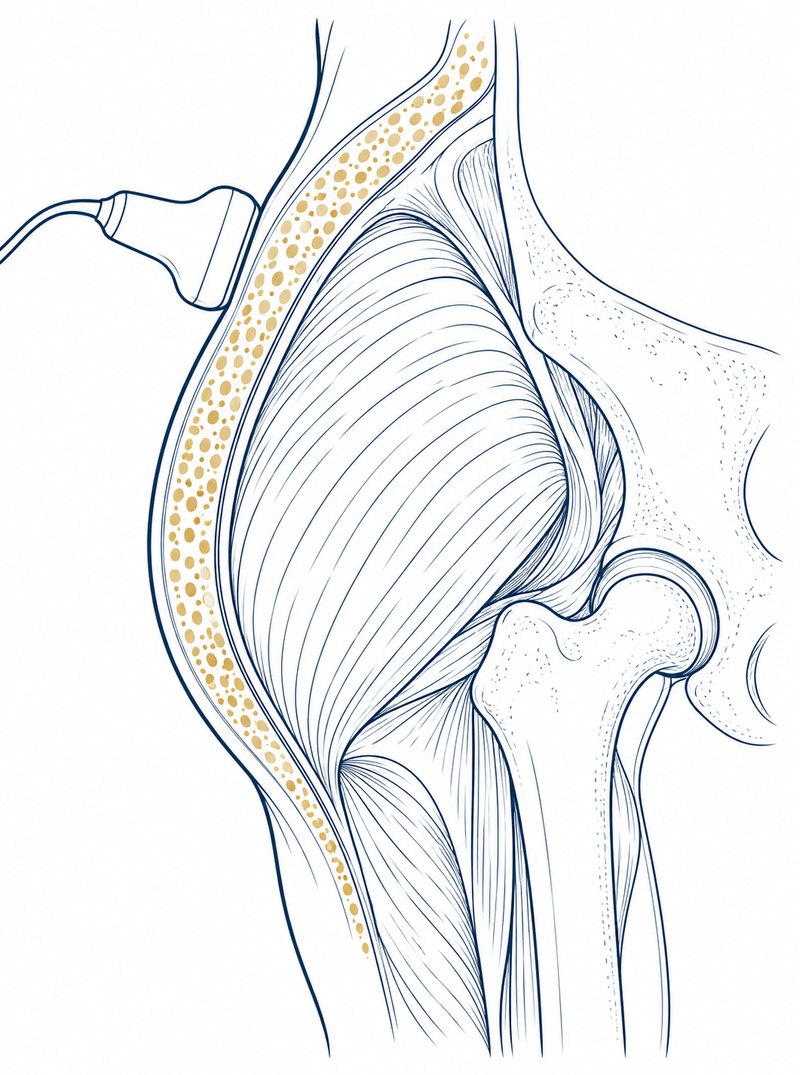
The fat (in gold) goes above the muscle, never into it, and I place it while watching it on ultrasound.
Why I recommend your own fat and not an implant
It’s not a trend. It’s because with the same surgery I do two things:
I increase the volume of the buttocks and shape the rest of your figure. The fat I place in the buttocks has to come from somewhere, and that same step defines your waist. The result depends on the whole, not on one isolated area.
It’s your own tissue. There’s no synthetic material inside the buttock and no risk of rejection. And fat brings stem cells and collagen, which improve the skin in that area.
I choose the size to be in harmony with your whole figure, not from a catalog.
If you were injected with biopolymers, that’s a different conversation
About twenty years ago, there was an explosion in Colombia of substances injected to enlarge the buttocks, and most of them were biopolymers.
At first they cause inflammation, and that inflammation gives an immediate result people like: the buttocks become firm, round, and bigger. That pleasing effect is the inflammatory process. Over time it brings pain, hardening, deformity, and infections. My recommendation is to have them removed as soon as possible.
If you’re not sure what you were injected with, that has to be assessed before considering anything else.
Were you injected with something and don't know what it was? That's the first question to answer.
Where I operate
I see you for consultations in my office in Cali, and I operate in a clinic. I don’t do any procedure in my office, not even a minor one: it’s for consultations, so I can explain everything calmly before you decide.
I operate in a fourth-level clinic —the highest level of care in Colombia’s health system— with full medical services: inpatient care, emergency, and intensive care. The operating room is certified by the regional Health Department.
I also operate in Pereira, in a clinic of the same level.
What this surgery doesn't do
It’s not for losing weight. If the goal is to lose weight, the tools are diet and exercise. And if you gain the weight back, your old figure comes back too.
It doesn’t fix your skin. Not cellulite, not stretch marks, not sagging. And when fat is removed, irregularities that were already there sometimes become more noticeable.
It doesn’t correct your skeleton. Asymmetries in the bones and the spine can’t be fixed with plastic surgery, and they can become more visible when fat is removed.
And you will have scars, even if they’re small. A scar is unavoidable whenever the skin is cut. What I can do is place them where they’ll show the least and close them so they heal as fine lines. The rest —your genetics, your diet, habits like smoking, and your own biology— is out of my hands.
I can’t guarantee an exact result. The result depends on your bone structure, muscle mass, hormones, age, skin type, diet, exercise, healing, and genetics: factors the surgeon doesn’t control. Plastic surgery, like medicine in general, is a commitment to the care provided, not to a guaranteed result.
The fear you bring is the usual one
About 98% of patients arrive at the consultation afraid, and the fear isn’t of the surgery itself: it’s of three specific things —the scar, the pain, and the anesthesia. Being common doesn’t make it unimportant: it means those are the three things you have every right to have explained in detail before you sign anything.
About pain, I’ll answer you with organization, not promises: there’s an anesthesiologist on the team dedicated to pain management during and after surgery, with oral and IV pain relief and pain pumps. And swelling is managed with post-op lymphatic drainage done by team members who specialize in it.
And what adverse events can occur
All of this is in the consent form you’ll sign. I’m telling you here so you can read it calmly at home, because a decision like this shouldn’t be made with a sheet of paper in your hand ten minutes before going into the operating room.
What’s specific to this surgery
Fat embolism. It’s uncommon: it happens when fat enters the bloodstream and reaches an organ.
It’s uncommon: it happens when fat enters the bloodstream and reaches an organ. It’s the most serious complication of fat grafting to the buttocks and can be life-threatening; that’s why I work above the muscle and with the ultrasound on.
When the fat is injected, a blood vessel in the buttock can also be injured; in extreme cases, this can affect circulation in the leg.
The most common problems are less serious: seromas —fluid in the tunnels the cannula leaves behind—, fibrosis, bruises that take a while to fade, contour irregularities, and a purplish web-like pattern on the skin that, in fair skin, sometimes doesn’t go away.
What applies to any surgery Bleeding that may require a transfusion, infection (which sometimes reaches deeper layers), reactions to medications and anesthesia, and blood clots that travel to the lungs.
Bleeding that may require a transfusion, infection (which sometimes reaches deeper layers), reactions to medications and anesthesia, and blood clots that travel to the lungs. They’re uncommon, but some can be serious and even life-threatening. If you smoke, the risk of healing problems and skin loss goes up.
If there’s a complication. You may need another surgery, a hospital stay, or medical treatment, and those costs are paid by the patient.
You may need another surgery, a hospital stay, or medical treatment, and those costs are paid by the patient. In Colombia, public health insurance doesn’t cover cosmetic surgery or its complications; that’s why there are specific insurance policies that cover up to 30 days after surgery, and clinics won’t operate without one.
If any of this worries you, that's exactly what we should talk about before you decide — not after.
Alternatives and related procedures
- Liposculpture and fat transfer — the technical basis of this procedure: this is where the “how” is.
- Tummy tuck — when there’s also loose skin on the abdomen or separation of the abdominal muscles.
- Biopolymer removal — the necessary first step if you’ve had injections before.
- Breast augmentation — because proportion is assessed from the side, between chest, waist, and buttocks.
How to prepare
- 1 · The consultation.
It’s a real conversation, not a formality. We go over your history and your expectations and determine the risks in your case. This is where we decide which of the four goals is yours, and whether the way to get there is your own fat or an implant.
- 2 · Lab tests.
They’re part of the preparation: they’re reviewed to make sure everything is in order before the procedure.
- 3 · Your habits.
Smoking affects healing.
What I need you to tell me
To assess you safely and recommend the best option for your case, I need to know all of your information:
- Previous surgeries, including implants or earlier procedures.
- Medications — everything you’re taking, including vitamins and supplements.
- Medical history: illnesses, allergies, or significant conditions.
- Tests and medical records. If you have previous results, bring them to the consultation.
When it comes to your health, no information is too small.
- You don’t need to know which surgery you need. That’s my job.
What does help is arriving knowing what bothers you and what you’d like to achieve: that’s how I understand your expectations and explain the options in your case.
Ask me everything —the procedure, the risks, recovery time, the results you can expect. There are no silly questions. If you’re an adult, you can bring someone with you to the consultation, though you don’t have to. If you’re a minor, you must come with a trusted companion.
Surgery shouldn’t be an impulse decision. Take all the time you need.
Getting back to your life
Cosmetic surgery is planned surgery, and recovery has to be planned too: a clean, suitable place to stay, someone to be with you, a balanced diet, plenty of fluids, and strict follow-through on prescriptions and follow-up visits. If you’re coming from another city or another country, for major surgeries you should set aside about a month.
Frequently asked questions
“Doctor, what if my result doesn’t look natural?” It’s one of the questions I get most, and the answer has three parts.
It’s one of the questions I get most, and the answer has three parts. The surgery follows technical parameters based on the body’s rigid structures —the skeleton and the muscles—: if the shape follows them, the result is natural. What changes are soft tissues, fat and skin, using techniques tailored to each case. And the third part doesn’t depend on me: if you follow the recovery instructions and back them up with a good diet and exercise, the result will be more than natural; it will be the best it can be.
Implants or my own fat? In most cases, I recommend fat: it increases volume, shapes your whole figure, and defines your waist in the same operation, and it uses your own tissue with no risk of rejection.
In most cases, I recommend fat: it increases volume, shapes your whole figure, and defines your waist in the same operation, and it uses your own tissue with no risk of rejection.
Where exactly is the fat injected? Above the muscle, in the fatty tissue, and watching it on ultrasound during surgery.
Above the muscle, in the fatty tissue, and watching it on ultrasound during surgery. Never into the muscle.
Can it be done together with other surgeries? Yes, and it usually is: liposculpture with buttock fat transfer together with a tummy tuck, or with breast surgery.
Yes, and it usually is: liposculpture with buttock fat transfer together with a tummy tuck, or with breast surgery. How much to combine in one operation is decided in the consultation.
How do I know a surgeon is properly trained? In Colombia, plastic surgery is a medical specialty of at least four years, completed at universities and teaching hospitals.
In Colombia, plastic surgery is a medical specialty of at least four years, completed at universities and teaching hospitals. To be certified, a surgeon’s degree has to be reviewed by the Ministry of Education, and they must be registered as a plastic surgeon in RETHUS, the national registry of health professionals. In my case: a specialization in plastic surgery at the Pontifical Catholic University of São Paulo, in Brazil, followed by certification and registration in Colombia. You can check this yourself, and I encourage you to.
If you're traveling from outside Colombia
If you’re coming from another city or another country, you’ll need to stay in Cali for several weeks after surgery. I’ll confirm the exact number of days in the consultation, because it depends on what we do. And you’ll need a suitable place to recover and someone to be with you.
It’s a minimum: if you can stay longer, even better. Once that time is up, you can fly home.
The next step
If you’ve read this far, you already know what this page hasn’t done: promise you a result. What I can do is sit down with you, look at your case from the front and from the side, and tell you which of the four goals is yours and which technique fits it. And also tell you no, if the answer is no.
Bring your questions in writing. Especially the uncomfortable ones.
The information on this page is educational and does not replace an in-person medical consultation. No result is guaranteed: what can be achieved in your case, and its risks, are discussed in consultation and set out in the informed consent form you sign before surgery.