
Liposculpture and fat transfer
Removing fat won’t give you a figure. Moving it will.
Taking fat out isn’t the same as putting it where it’s needed. That distinction decides whether your result shows or not, and it’s the one almost nobody explains before you pay. The question I’ll ask you in the consultation is this: do you want to look thinner, or better shaped? They’re not the same, and they don’t come from the same surgery.
- It’s not for losing weight: it’s for the fat that won’t go away with diet or the gym.
- I look at you from the side, because contour is about the whole body, not one area.
- If what you have too much of is skin, not fat, this isn’t your surgery — it’s a tummy tuck, and the two are often done together.
Send me your case and I'll tell you whether it's fat or skin.
Dr. Saad or his team will reply. No commitment.
What it is
They’re two different things, and it’s worth knowing which one you’re being offered.
Liposuction is only the act of removing fat from specific areas. Fat is suctioned out of one area, and that’s it.
Liposculpture is the complete procedure: I remove fat in an orderly, step-by-step way across the whole body, and I use part of that fat to add fullness where it’s needed. It’s not about one area: it’s about shaping your whole figure.
The difference isn’t one of intensity; it’s one of goal. One takes volume away from a spot. The other redistributes volume to change proportions. The result is completely different.
Fat transfer is that second half: the fat I removed is processed and injected back where volume is missing —usually the buttocks and hips. It’s your own tissue, not a synthetic material.
A note on vocabulary, because you may hear it in Colombia: some people call a small lipo “suave brisa” (“soft breeze”). It’s a misleading name. If that’s what you’re offered, you’re being offered liposuction of a specific area, not liposculpture.
When I work on the full contour, I call it 360 liposculpture, and in some cases I do it with VASER.
How I do it: the fat layer and the ultrasound
This is the part I most want you to understand, because it’s where the safety of this surgery lies.
- The fat doesn’t go into the muscle. I place it above it
In the fatty tissue of the buttock, in what we call the supramuscular plane.
And I don’t do it blind. Today we have portable ultrasound devices, with the image on a phone or an iPad. During surgery, we cover the ultrasound probe with a sterile sleeve to keep it sterile, and with it we watch how deep the cannula that injects the fat is going, and into which tissue. That’s the current technique, the most advanced one.
Why do I care so much about avoiding the muscle? Because that’s where the real risk of this surgery is: if fat gets into the muscle, it can enter the bloodstream, and that’s what’s dangerous. That’s why it’s avoided, and the fat is placed in the subcutaneous tissue, the fatty tissue of the buttock.
I don’t use ultrasound only in the buttocks: it works in any other part of the body where I’m placing fat.
In medical terms, in case you want to compare notes with your own surgeon Autologous fat grafting in the supramuscular plane under intraoperative ultrasound guidance, with the probe covered by a sterile sleeve. The intramuscular plane is deliberately avoided because of the risk of fat embolism, the fatal complication associated with buttock fat grafting.
Want to know whether this is right for your case? Send me what you have and we'll take a look.
- And there are two options for the buttocks.
One is an implant: a synthetic material placed inside the buttock. The other is your own fat. I recommend the fat, and not only because it looks more natural: with the same surgery I shape the rest of your figure and define your waist, and fat carries stem cells and collagen that improve the skin in that area. I choose the size to be in harmony with your whole figure, not from a catalog.
-
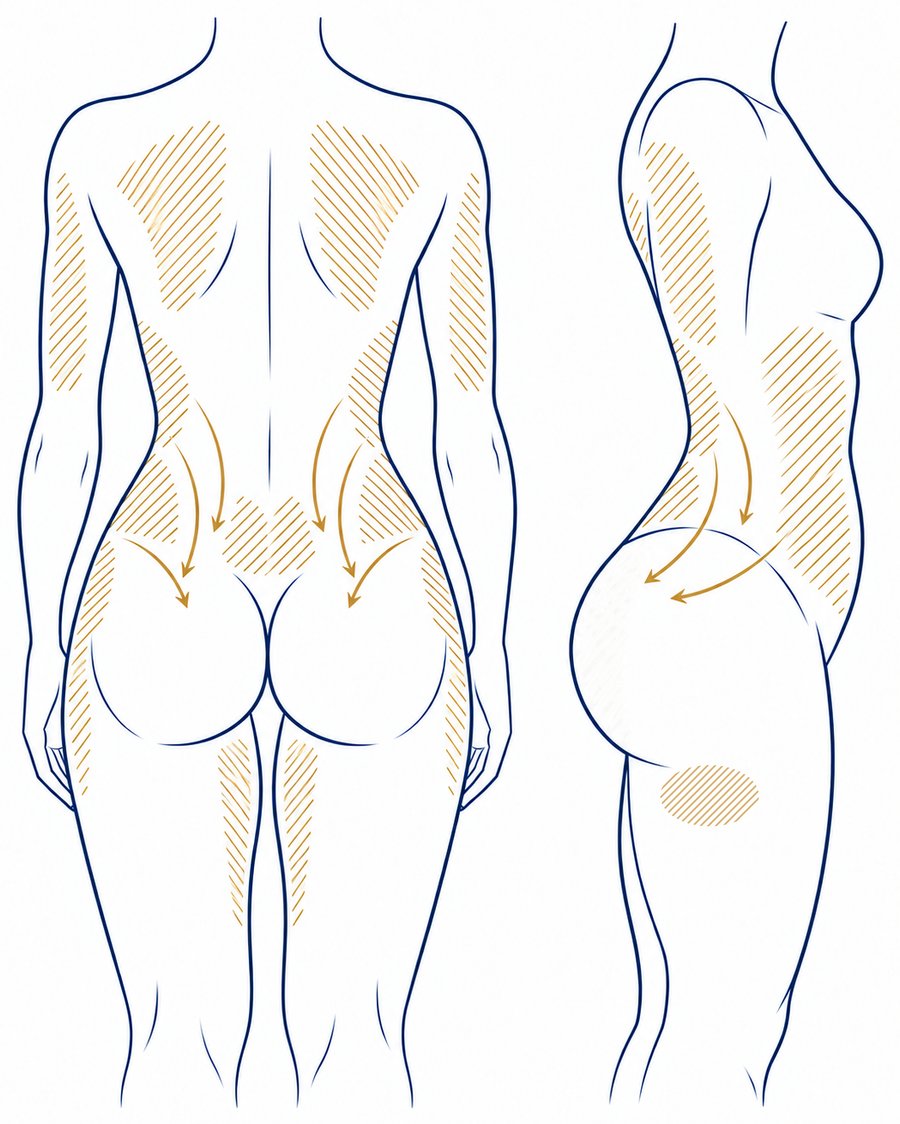
Hatched: the areas I take fat from (back, waist, hips, inner thighs, thighs and the back of the arms). Arrows: the fat I move to the buttocks.
How I decide: I look at you from the side
When I decide on proportions, I don’t look at a list of areas: I look at a silhouette.
From the side, you can see the real relationship between the size of your breasts, your waist, and your buttocks, and that relationship is what makes a figure look balanced or not. That’s why two people with the same weight and the same areas “to treat” may need different surgeries.
If you have extra skin as well as fat, liposculpture alone won't solve it. That's a different conversation.
Where I operate
I see you for consultations in my office in Cali, and I operate in a clinic. I don’t do any procedure in my office, not even a minor one: it’s for consultations, so I can explain everything calmly before you decide.
I operate in a fourth-level clinic —the highest level of care in Colombia’s health system— with full medical services: inpatient care, emergency, and intensive care. The operating room is certified by the regional Health Department.
I also operate in Pereira, in a clinic of the same level.
What you get
- Fat is redistributed, not just removed.
The extra fat at your waist and back is the same fat I use to add volume to your buttocks. One operation, two goals.
- Proportions change, not just volume.
Some procedures only reduce volume; others transform proportions. This is the second kind.
- It’s your own tissue.
There’s no synthetic material inside your body, and the transferred fat brings stem cells and collagen to the skin of the area that receives it.
- Sometimes the goal isn’t cosmetic.
I operated on the hips and thighs of a 61-year-old patient with a different stated goal: to reduce the volume of fatty tissue so that, with a structured exercise program and muscle gain, her mobility would improve.
Three things this surgery doesn't do
It’s not for losing weight. If your goal is to lose weight, this isn’t the tool: diet and exercise are, in that order. And if you gain the weight back, your old figure comes back too.
It doesn’t fix your skin. Not cellulite, not stretch marks, not sagging. Plastic surgery can’t change the tone of your skin or your muscles. And when fat is removed, irregularities that were already there sometimes become more noticeable.
It doesn’t correct your skeleton. Asymmetries in the bones and the spine —one hip higher than the other— can’t be fixed with plastic surgery, and removing fat can make them more visible.
And you will have scars, even if they’re small. A scar is unavoidable whenever the skin is cut. What I can do is place them where they’ll show the least and close them so they heal as fine lines. The rest —genetics, diet, habits like smoking, and each person’s own biology— is out of my hands.
And what adverse events can occur
All of this is in the consent form you’ll sign. I’m telling you here so you can read it calmly at home, because a decision like this shouldn’t be made with a sheet of paper in your hand ten minutes before going into the operating room.
What’s specific to this surgery
Fat embolism. It’s uncommon: it happens when fat enters the bloodstream and reaches an organ.
It’s uncommon: it happens when fat enters the bloodstream and reaches an organ. It’s the most serious complication of fat grafting to the buttocks and can be life-threatening; that’s why I work above the muscle and with the ultrasound on.
When the fat is injected, a blood vessel in the buttock can also be injured; in extreme cases, this can affect circulation in the leg.
The most common problems are less serious: seromas —fluid in the tunnels the cannula leaves behind—, fibrosis, bruises that take a while to fade, and a purplish web-like pattern on the skin that, in fair skin, sometimes doesn’t go away.
What applies to any surgery Bleeding that may require a transfusion, infection (which sometimes reaches deeper layers), reactions to medications and anesthesia, blood clots that travel to the lungs, and, very rarely, perforation of an organ.
Bleeding that may require a transfusion, infection (which sometimes reaches deeper layers), reactions to medications and anesthesia, blood clots that travel to the lungs, and, very rarely, perforation of an organ. They’re uncommon, but some can be serious and even life-threatening. If you smoke, the risk of healing problems and skin loss goes up.
If there’s a complication. You may need another surgery, a hospital stay, or medical treatment, and those costs are paid by the patient.
You may need another surgery, a hospital stay, or medical treatment, and those costs are paid by the patient. In Colombia, public health insurance doesn’t cover cosmetic surgery or its complications; that’s why there are specific insurance policies that cover up to 30 days after surgery, and clinics won’t operate without one.
What I can’t guarantee. Not measurements, not weight, not perfect symmetry.
Not measurements, not weight, not perfect symmetry. The human body is asymmetrical to begin with, and removing fat can make those asymmetries more visible. Plastic surgery, like medicine in general, is a commitment to the care provided, not to a guaranteed result.
If any of this worries you, that's exactly what we should talk about before you decide — not after.
Alternatives and related procedures
- Tummy tuck — if what you have too much of is skin and the muscles are separated, liposculpture won’t solve it. The two are often done in the same surgery.
- Buttocks — fat transfer is the option I recommend over implants. The buttocks can also be reduced or lifted.
- Breast augmentation — often combined with liposculpture and buttock fat transfer in the same procedure.
- Biopolymer removal — important: if you were injected with “fat” or any other substance in your buttocks outside an operating room, that isn’t fat transfer. Biopolymers are foreign substances that will always cause an immune reaction, and removing them isn’t optional.
- About Dr. Saad Barhoum — training, certification, and registration.
How to prepare
- 1 · The consultation.
It’s the first of the three acts. We talk, go over your medical history and your lab tests to make sure everything is in order, and discuss expectations. In this surgery that part isn’t a formality: that’s where we decide which areas we’ll work on, where the fat will go, and what proportion we’re aiming for. And that’s where I also look at you from the side.
- 2 · Lab tests.
They’re part of the preparation.
What I need you to tell me
To assess you safely and recommend the best option for your case, I need to know all of your information:
- Previous surgeries, including implants or earlier procedures.
- Medications — everything you’re taking, including vitamins and supplements.
- Medical history: illnesses, allergies, or significant conditions.
- Tests and medical records. If you have previous results, bring them to the consultation.
When it comes to your health, no information is too small.
- You don’t need to know which surgery you need. That’s my job.
What does help is arriving knowing what bothers you and what you’d like to achieve: that’s how I understand your expectations and explain the options in your case.
Ask me everything —the procedure, the risks, recovery time, the results you can expect. There are no silly questions. If you’re an adult, you can bring someone with you to the consultation, though you don’t have to. If you’re a minor, you must come with a trusted companion.
Surgery shouldn’t be an impulse decision. Take all the time you need.
- 3 · If liposculpture is combined with a tummy tuck: an abdominal wall ultrasound.
When I combine the two procedures, before surgery I do an ultrasound of the abdominal wall to check for hernias above or below the belly button and to measure the separation of the abdominal muscles. That’s how I plan.
- 4 · Plan your time, not just your surgery.
If you’re coming from abroad: get in touch with a certified plastic surgeon, plan properly with them, and set aside enough time both for the trip and for recovering in the city where you have surgery.
Getting back to your life
- These timelines are for this surgery, and only this one.
First 2 weeks Lymphatic drainage massages, done by members of my team. The fluid that builds up in the tunnels left by the cannula needs help draining out. First 3 months A compression garment, plus a rigid board over the abdomen. Every day. And no sun: if you tan now, the bruises can leave permanent brown spots. From 3 to 6 months The overall swelling goes down on its own. The irregularities of the first few weeks resolve during this stretch. When you’ll see it Once the swelling is completely gone. Before then, you’re not seeing your result: you’re seeing swelling. Recovery is part of the procedure, not an add-on. You need a clean, suitable place to stay, someone to be with you, a balanced diet and plenty of fluids, and strict follow-through on prescriptions and follow-up visits. My team includes staff trained in post-op lymphatic drainage and an anesthesiologist who specializes in pain management, both during surgery and afterward.
Frequently asked questions
Liposculpture or liposuction? Aren’t they the same? No.
No. Liposuction is only removing fat from specific areas. Liposculpture is the complete procedure: I remove fat in an orderly, step-by-step way across the whole body to shape your figure, and I reuse part of that fat to add fullness. The result is completely different. And watch out for the vocabulary: the “suave brisa” offered in some places is a misleading name for a small lipo.
Will it help me lose weight? That’s not what it’s for.
That’s not what it’s for. Ask yourself first: do you want to look thinner, or better shaped? They’re different things, and only one of them is surgical. And for the best result, you need to follow your recovery instructions and back them up with a good diet and exercise routine.
My own fat, or buttock implants? Both options exist, and I recommend fat: in the same surgery I shape your whole figure and define your waist, the volume comes from your own tissue rather than a synthetic material inside the buttock, and the fat brings stem cells and collagen to the skin.
Both options exist, and I recommend fat: in the same surgery I shape your whole figure and define your waist, the volume comes from your own tissue rather than a synthetic material inside the buttock, and the fat brings stem cells and collagen to the skin.
Where exactly is the fat injected? In the supramuscular plane: I don’t inject it into the muscle.
In the supramuscular plane: I don’t inject it into the muscle. And it isn’t done by eye — I place it while watching the ultrasound in real time, with the probe in a sterile sleeve, so I know which tissue the cannula is entering and how deep.
Can it be done with a tummy tuck, in the same surgery? Yes, and that’s what I usually do: first the liposculpture —removing the extra fat and transferring it to the buttocks— and then the abdomen: separating the skin from the muscle, stitching the abdominal muscles back together, removing the extra skin, and repositioning the belly button.
Yes, and that’s what I usually do: first the liposculpture —removing the extra fat and transferring it to the buttocks— and then the abdomen: separating the skin from the muscle, stitching the abdominal muscles back together, removing the extra skin, and repositioning the belly button.
If you're traveling from outside Colombia
What changes when you have surgery abroad isn’t the surgery: it’s how long you need to stay, who sees you once you’re back home, and when you can fly.
If I only do a liposculpture: a minimum of 20 days in the city. For 360 lipo, the recommended minimum is 20 to 25 days. If it’s combined with a breast lift, a tummy tuck or biopolymer removal, the minimum is one month. It’s a minimum: if you can stay longer, even better. Once that time is up, you can fly home.
The next step
If what you have is stubborn, localized fat and what you’re missing is shape, this is a conversation for a consultation, not a catalog. It’s decided by looking at you, from the front and from the side.
The information on this page is educational and does not replace an in-person medical consultation. No result is guaranteed: what can be achieved in your case, and its risks, are discussed in consultation and set out in the informed consent form you sign before surgery.